Budget, AI, and Public Service: Korea’s 2027 Vision
South Korea’s proposed 2027 budget puts major investment into AI while also advancing plans to make public services more accessible, creating new opportunities …
South Korea’s proposed 2027 national budget sends a clear message: AI is becoming a major priority for the country’s future growth and for the way the government serves its people.
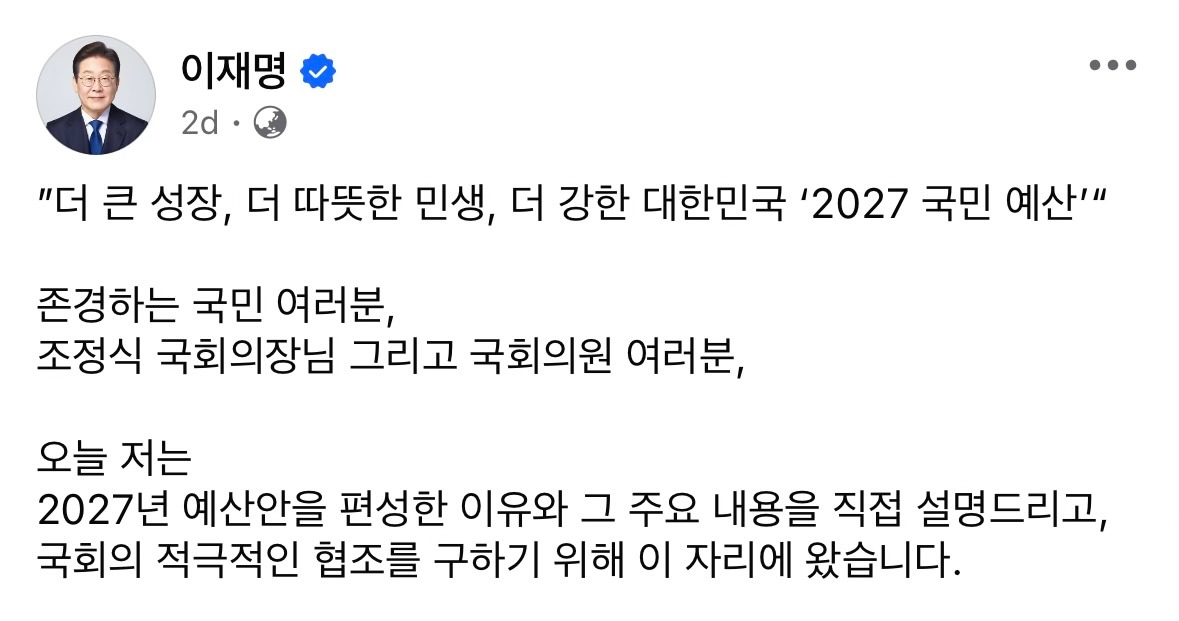
President Lee Jae Myung shares his 2027 budget speech, titled “Greater Growth, Warmer Livelihoods, and a Stronger Korea,” on Facebook.
The government has proposed a record ₩820.9 trillion budget, a 12.8% increase from the 2026 main budget. Under the theme “Greater Growth, Warmer Livelihoods, and a Stronger Korea,” the plan places substantial investment in AI while also emphasizing more accessible and responsive public services. [1]
The two priorities are increasingly connected. As Korea invests in AI technologies, it is also looking at how these tools can be used in everyday public services. This creates opportunities for AI companies to develop solutions that address public needs, working alongside government agencies and local governments. [1][2][3]
AI at the Centre of Korea’s Growth Strategy
A major part of the proposed budget is dedicated to AI and advanced technologies. The government plans to invest ₩21.3 trillion in three mega projects: semiconductors, physical AI, and AI data centres, alongside broader AI investment that is nearly double the previous year’s level. [2]
The plan also includes ₩500 billion for physical AI demonstrations across eight public and private sectors, including manufacturing, smart factories, and defence. Another ₩4.7 trillion is allocated for frontier AI development, while investment in supporting infrastructure such as power, water, and industrial complexes is also planned. [2]
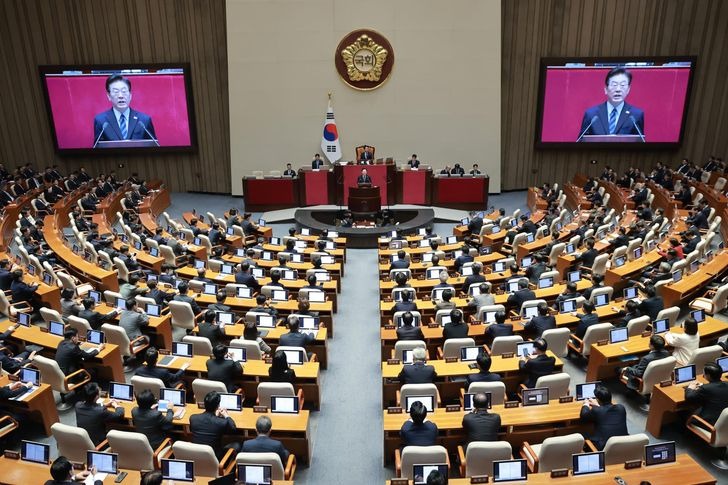
Lawmakers listen as President Lee Jae Myung delivers his 2027 budget speech at the National Assembly in Yeouido, Seoul. (Yonhap)
These investments show that Korea sees AI not simply as a technology sector, but as a tool for transforming industries and strengthening the country’s future competitiveness. However, AI’s role is not limited to factories, research laboratories, or businesses. The government is also looking at how AI can help people interact with public services more easily.
From AI Investment to Everyday Government Services
The proposed budget also emphasizes the use of AI in public administration. Under the “AI for All” initiative, the government aims to help people identify relevant public services and apply for them through AI based tools. [2]
The Ministry of the Interior and Safety is also planning an AI Integrated Civil Service Platform, designed to provide guidance and handle administrative requests through a single AI channel. The proposed allocation for the platform rises from ₩1.8 billion in 2026 to ₩20.3 billion in 2027. The ministry also plans to expand Benefit Alert, which proactively informs people about government benefits they may be eligible to receive. [3]
These initiatives suggest that AI is being considered not only for economic growth, but also as part of the public service experience. If implemented effectively, AI tools could help people find information, understand procedures, and access services with fewer barriers.
This shift also creates a new space for AI companies. Alongside developing technologies for commercial and industrial use, companies can contribute by building tools that help government agencies communicate with residents, respond to inquiries, and make administrative information easier to access.
Making AI Services More Accessible
Local governments are particularly important in this process. They are close to residents’ everyday needs and can work with technology companies to develop and test solutions for specific public service challenges.
A practical example is the collaboration between Ansan City and Hello Friends, which are developing and testing an AI chatbot to help foreign residents access administrative information. The project uses specialized administrative data, laws, manuals, and more than 100,000 consultation records to support inquiries in 28 languages. [5]
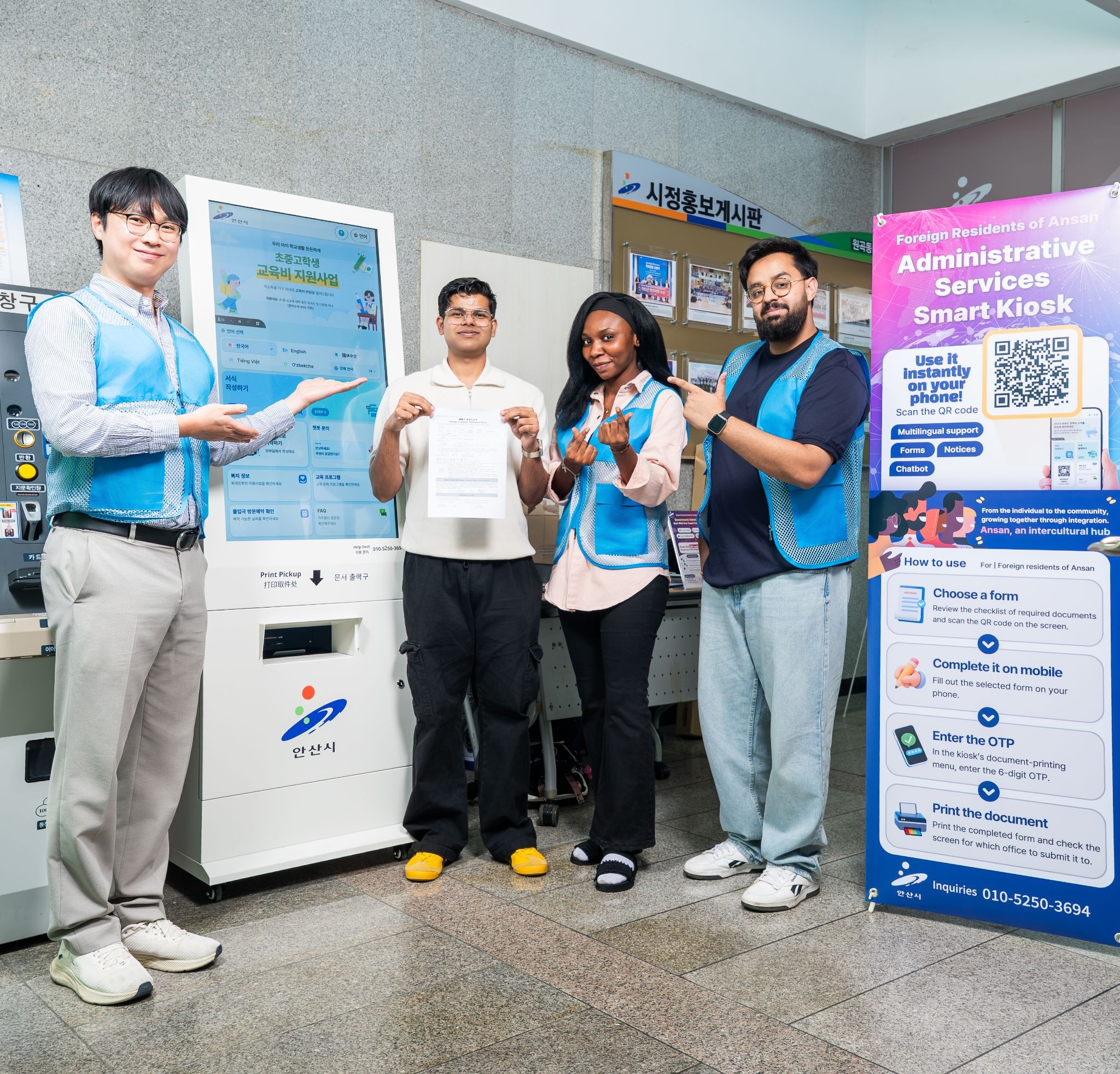
Ansan City and Hello Friends’ AI kiosk helps foreign residents access administrative information and services.
The initiative is being developed through a GovTech AI demonstration and commercialization program and is intended to be tested in real world settings. It aims to address language barriers and make administrative information more accessible to foreign residents. [5]
The Ansan case illustrates how a local government and an AI company can work together on a public facing solution. Rather than applying AI in a general way, the project focuses on a specific community need: helping residents understand and navigate public services.
For AI companies, this points to an opportunity to work with local governments on solutions tailored to residents’ needs. For local governments, partnerships with technology firms can provide a way to test new approaches and improve service delivery.
More Than a Technology Budget
Korea’s 2027 budget proposal highlights two developments: substantial investment in AI as a driver of future growth, and a growing interest in using AI to improve public services. [1][2][3]
As these priorities move forward together, public service innovation could become an important area for AI development. The Ansan and Hello Friends project offers one example of how that collaboration can take shape at the local level. [5]
The proposal still requires National Assembly approval, and the impact of these initiatives will depend on how they are implemented. But the direction is clear: AI is being positioned not only as an engine of economic growth, but also as a tool for making government services more accessible and responsive.
For AI companies, this means public service can be another area for meaningful innovation. For local governments, it creates an opportunity to work with those companies to develop practical solutions that respond to the needs of their communities.
Keep reading the GoBridge blog for more insights into how Korea’s AI ambitions are shaping public services and creating new opportunities for innovation.
Bibliography
[1] Korea.kr. “2027년도 예산안 820.9조 원, 역대 최대…162조 미래대응기금 신설.”
https://www.korea.kr/briefing/policyBriefingView.do?newsId=148970973
[2] Korea.kr. “이 대통령 ‘2027년 예산안은 성장확산 예산…’”
https://www.korea.kr/news/policyNewsView.do?newsId=148974746
[3] Ministry of the Interior and Safety. “행안부, 2027년 예산안 84조 7,036억 원 편성…전년 대비 10.1% 증가.”
[4] Ministry of the Interior and Safety. Official English website.
https://www.mois.go.kr/eng/a01/engMain.do
[5] Yonhap News Agency. “안산시, 외국인 주민 민원 안내용 AI챗봇 개발…26개 언어 지원.” June 10, 2026.
https://www.yna.co.kr/view/AKR20260610046400061
Article by Ahmad Bin Aamir